The argument in our family about Moroccan pastilla has been going on since 1989, and no one has won it yet. My grandmother Yamna started it. Brahim, our cook, who has been in this kitchen for forty years and has the patience of geology about almost everything, has been losing his side of it ever since, though he would not describe it that way. He would describe it as ongoing. My brother Hamza has a position. I have a position. Our positions are not the same. They are rarely even close.
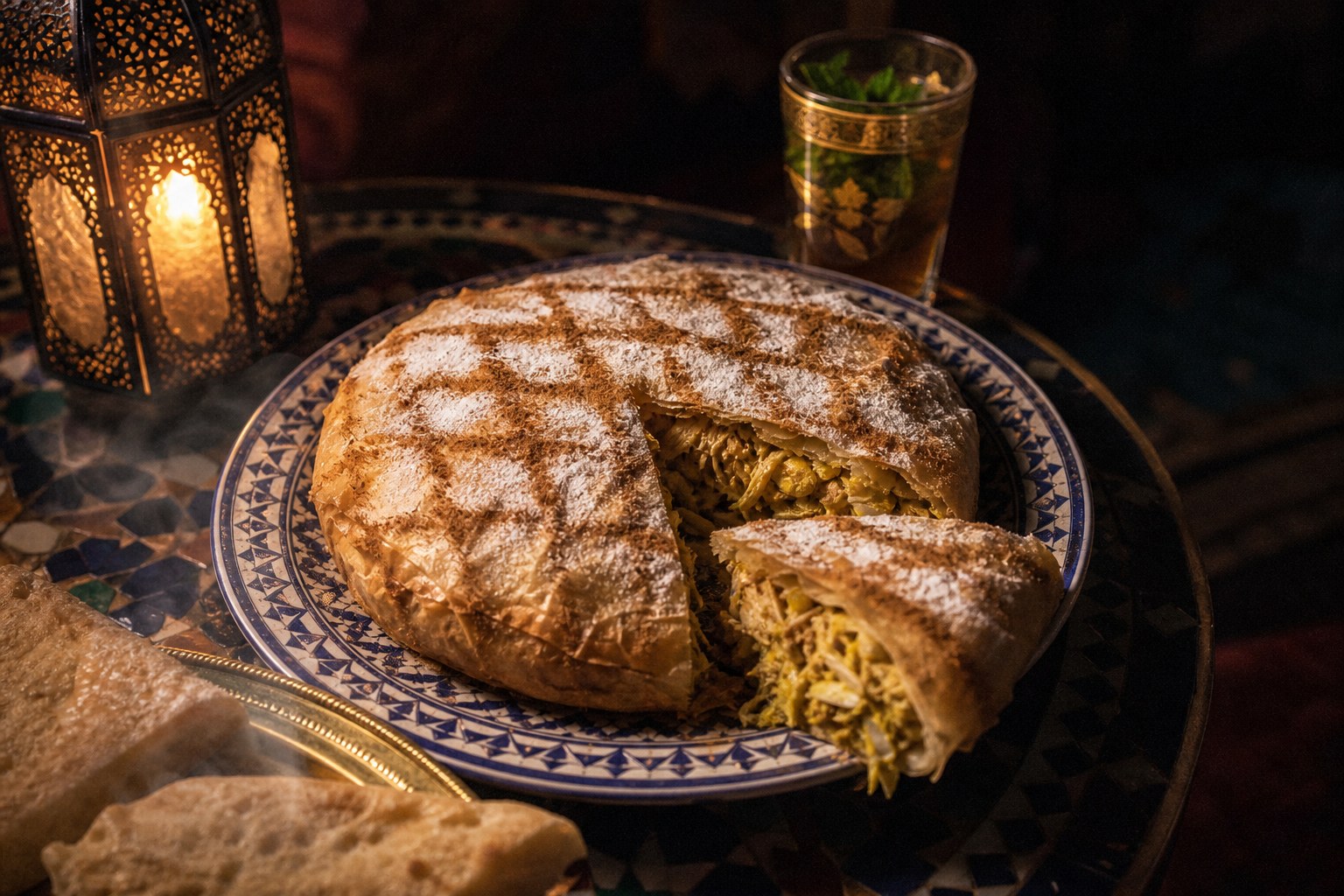
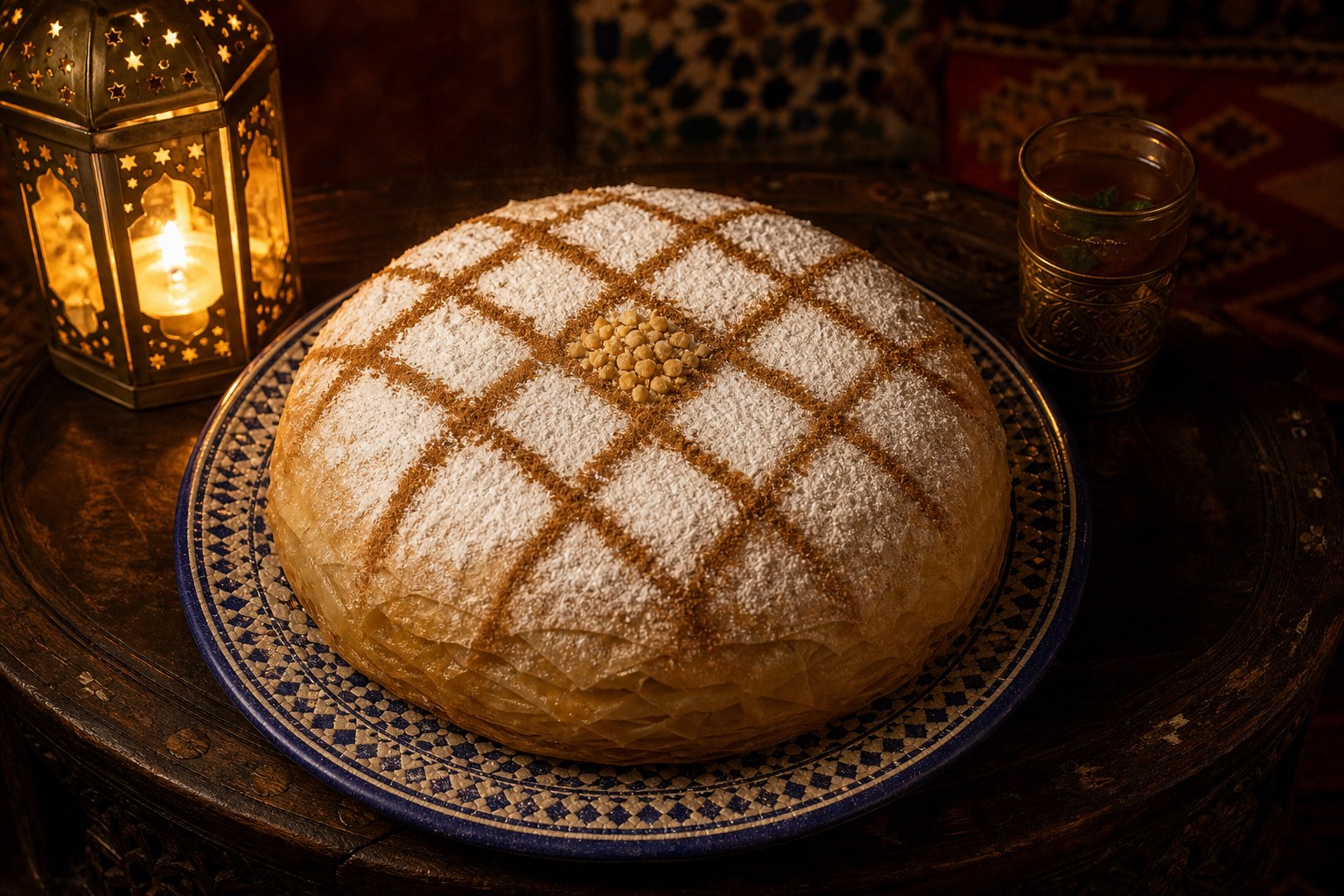
The dish itself, for anyone who hasn't had it: pastilla is a large, circular pastry made from warqa, a thin, almost translucent sheet of pastry similar in concept to filo, but made differently and tasting nothing like it, filled with spiced slow-cooked pigeon (or chicken, and that is already the argument), almonds, and an egg custard made from the braising broth, then sealed, baked, and dusted generously with cinnamon and powdered sugar. It is savoury. It is sweet. It is served as a starter. It is served as a main. It is, in some households, served as a meal unto itself. This is why the argument never ends: pastilla refuses to be categorised, and our family is full of people who believe in categories.
What pastilla actually is
Let's start with the warqa, because the warqa is where most outside descriptions go wrong. Warqa is not filo. If you arrive at our kitchen expecting filo, the crisp, brittle layers you find in baklava or spanakopita, you will be eating something different from what you imagined. Warqa is made by daubing a ball of wet, almost liquid dough against a very hot smooth surface in overlapping circular strokes, each pass leaving a paper-thin, slightly translucent film that sets almost instantly on contact with the heat. You build up two or three of these films, one on top of another, and then you peel the whole thing off in a single sheet. The technique is fast. It is also unforgiving, and it takes years to get right without tearing.
Most restaurants in Marrakech buy their warqa from specialists in the souk. We make ours. The distinction is not a point of pride for its own sake, it is a practical difference in the result. Bought warqa is slightly thicker, less translucent, and when baked it stays somewhat pliable. Our warqa, made fresh the morning it's used, is different: it shatters. Press a fork through it and the pastry breaks cleanly, almost like a cracker, and the shards hold their shape on the plate. That shatter, and the way it contrasts with the yielding custard just beneath the crust, is half of what pastilla is. See what we serve on our menu.
The pigeon question
The traditional Moroccan pastilla is pigeon. Full stop. I will not entertain other opinions at this point in the article, even though I will be forced to entertain them shortly. The pigeon is braised low and slow with onion, saffron, ginger, cinnamon, and black pepper until it falls apart entirely, giving up its meat to the broth and leaving behind something rich and dark and deeply perfumed. The broth is then reduced to a thick, egg-enriched custard. The meat is layered in the centre of the warqa with a mixture of fried almonds, blanched, fried in oil until golden, then ground coarsely with cinnamon and sugar, and then the whole assembly is wrapped and sealed and baked until the outside is crackling and amber.
Then, when it comes out of the oven, you dust the top with more cinnamon and more icing sugar. A generous hand. This is not a subtle finishing touch. It is an announcement.
The result: the egg custard has seeped into the warqa from beneath, softening it just slightly without dissolving it. The almonds have stayed crunchy inside the steam of the filling. The pigeon is completely yielding and still fragrant from the saffron. And the outside is sweet with the sugar and warm with the cinnamon, which means the first thing you taste is something almost like a dessert, and then the savoury comes through from below, and then the almond crunch, and then something darkly pigeon-ish from the middle. That sequence of four things in a single bite is the dish.
My answer to the pigeon or chicken question: pigeon, always, unless it's chicken. I am being slightly difficult here. The honest answer is: pigeon.
"You dust the top after it comes out of the oven. A generous hand. This is not a subtle finishing touch, it is an announcement."
Youssef, on the cinnamon and sugar
The chicken compromise, and why it exists
My grandmother Yamna started substituting chicken for pigeon at some point in the 1970s, when sourcing live pigeons from the souk became unreliable. This was a practical decision. She was running a busy household kitchen, she had six people to feed, and pigeons were not always available. Chicken was always available. She made the swap and didn't announce it, and my grandfather didn't notice for three months, which she found satisfying.
My father has accepted the chicken version since he was a child. Hamza accepts it, he'd say it's a perfectly sound alternative and that insisting on pigeon is theatrical. Brahim does not accept it. He has been making a parallel pigeon pastilla, quietly, alongside the chicken version, ever since Yamna made the substitution standard. He has never once suggested this was a problem. He just makes both, and if you order pastilla at our restaurant, you can choose. He would prefer you chose pigeon, but he will not say so. He will look at you, briefly, and you will understand.
In practice, the chicken version is more consistent, the meat is lighter, the texture more uniform, and it is easier to source well throughout the year. It is also more accessible to guests who hesitate at pigeon, which is a not-uncommon hesitation and one we respect. The pigeon version is richer, darker, more complex in the finish, it is the dish that the Moroccan royal kitchen refined over centuries for exactly this kind of occasion. Both versions are on our menu. My recommendation: if this is your first pastilla, start with chicken. If you've had it before and you know what you're doing, order the pigeon. Brahim will be quietly pleased.
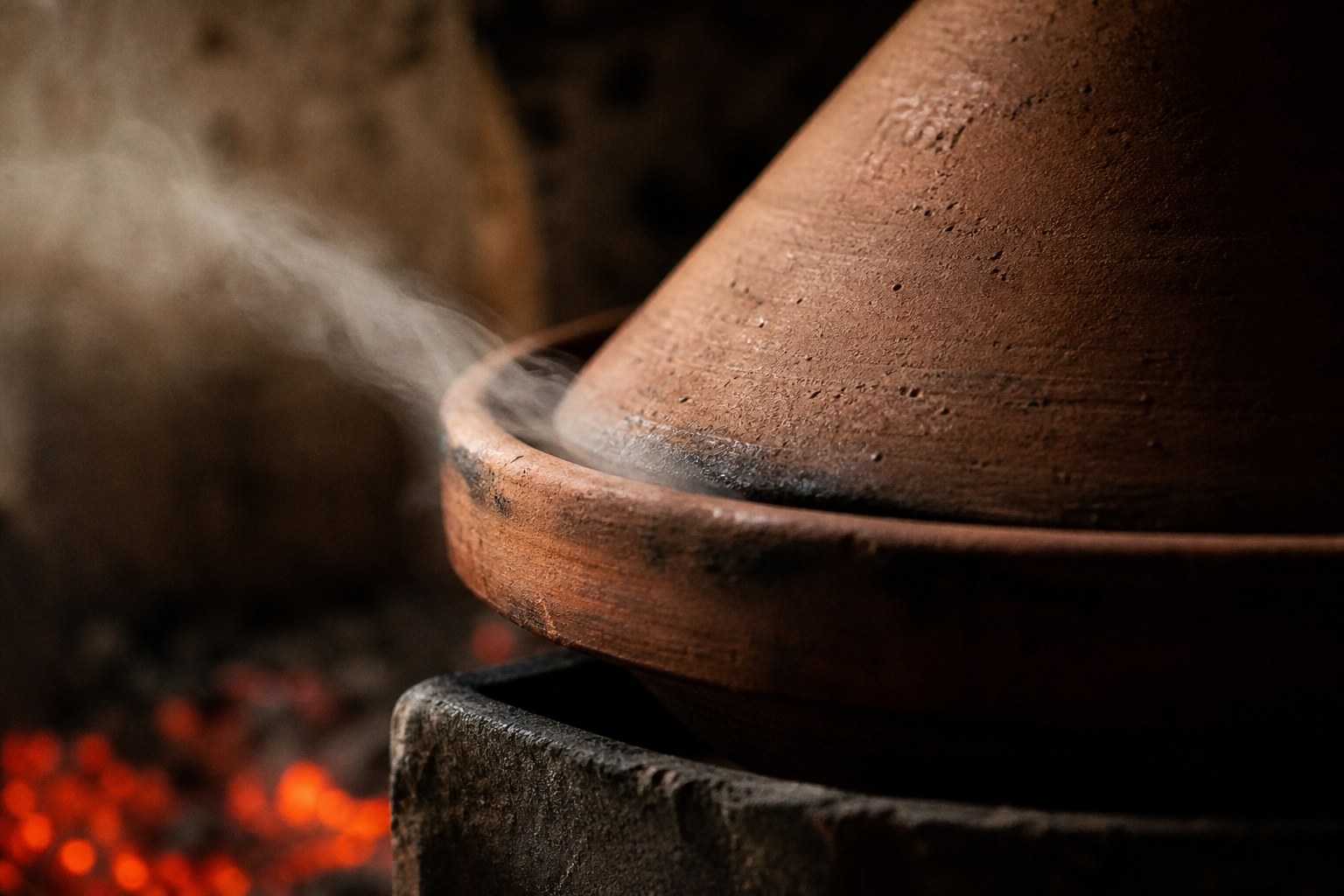
If tagine is our weekday, the steady, patient, daily dish, the one Brahim puts on the fire at five-twenty every morning, then pastilla is the celebration. You can read about the tagine in our piece on the slow geometry of clay and coal, which covers the patience required for that dish. Pastilla requires a different kind of patience: more assembly, more precision, more argument about which bird.
Sweet, savoury, the logic of it
The combination that surprises people most is the sugar on top. They arrive expecting a savoury pastry and find cinnamon and icing sugar on the outside, and they either trust it immediately or look slightly uncertain. The uncertainty is understandable. In most culinary traditions you are eating in one lane or the other: savoury or sweet, starter or dessert. Pastilla refuses.
It shouldn't surprise anyone who knows Moroccan food history. Morocco has been layering sweet and savoury in the same dish since the trade routes from the south brought cane sugar into the medina kitchens in the twelfth century. The ras el hanout spice blend, the foundation of half the dishes in this kitchen, is itself partly sweet: cinnamon, cloves, dried rosebuds, allspice, all sitting alongside cumin and coriander and black pepper. The whole culinary tradition has been comfortable with sweetness in savoury context for nine hundred years. Pastilla is simply the dish where that logic reaches its most explicit, most committed form. The sugar on top is not a mistake. It is the point. It is where the whole eight-hundred-year argument about Moroccan flavour arrives at a verdict.
Marrakech dining tends to do this across the board, the city's food has never been interested in keeping flavours separate. If you want to understand the wider landscape of where pastilla sits among what the medina offers, our piece on where to eat in Marrakech gives a broader frame. And if you enjoy dishes that provoke strong opinions, wait until someone gets you started on tanjia, the other dish no one in this city fully agrees on.
When we serve it
Pastilla is a celebration dish, always has been. It appears at weddings, at Eid al-Adha, at any gathering where someone has decided the occasion deserves the effort. In our restaurant it is available every day, but it sells fastest on Friday evenings, when guests arrive with the appetite and the patience for a full three-course meal, and a starter as substantial and involved as pastilla makes genuine sense in that context.
It is not a quick starter. It takes roughly twenty minutes from assembly to table; we prepare the filling and the warqa in advance and build each pastilla to order. On busy evenings, particularly Fridays, Saturday nights, and during Ramadan, when the appetite for celebration dishes spikes considerably, we run low. If pastilla is what you are coming for, make a reservation and tell us when you book. We will make sure there is one with your name on it.
Youssef's verdict
After approximately two thousand slices, and I am not exaggerating, I have been eating this dish since before I had opinions about anything, and I have had opinions about this dish since the first time I tasted it and immediately asked for another, here is what I know: pastilla is a good-mood dish. It doesn't work when you're tired or distracted or eating in a hurry. It is the kind of food that requires you to be paying attention, and when you are, it rewards that attention in a very specific sequence.
The cinnamon hits first. Then the yielding egg custard just below the crust. Then the almond crunch, slightly resistant, warm from the spice, in the middle layer. Then something dark and perfumed and savoury from the pigeon, which arrives late and lingers. Then the cinnamon again on the finish, cycling back to where you started. That is four separate things happening in one bite, in that order, reliably. If you eat it quickly, you collapse the sequence and miss at least two of them. Don't eat it quickly.
The argument continues
The family argument about pastilla is still going on. It will still be going on when you arrive. We have not reached a conclusion, on the pigeon-versus-chicken question, on the sweet-versus-savoury framing, on whether it should be a starter or a main, on whether Yamna was right or wrong to make the compromise she made in the 1970s. The dish is too good at being both things at once to ever settle the question of which thing it really should be.
Come try it. Eat it slowly. Form your own opinion. You can join the argument at the table if you like, Hamza will give you the measured, historically grounded version of events, and Brahim will give you a look that communicates his position without words. I'll be on the rooftop. I've already had mine.