Brahim is sixty-eight. He will tell you the difference between a tanjia and a tagine in one sentence, and then he will look at you until you understand it. The sentence is this: "A tagine is what you cook at home. A tanjia is what Marrakech cooks for itself." He does not say this to be poetic. He says it because it is a technical distinction and he finds it irritating that it needs explaining. This article is the explanation he refuses to give.
Most tourist restaurants in the medina serve tagine. Fewer serve tanjia. There is a reason for this, and the reason is not that tanjia is difficult. The reason is that it requires discipline, you cannot start a tanjia at noon for a table who sits down at eight. You start it the evening before and collect it in the morning. If a kitchen is not willing to think that far ahead, they will not serve tanjia. Most are not willing. The ones that are will not always tell you when it is ready.
We serve it at Le Vrai Traditionnel on Fridays. Brahim decides when it is ready. He learned to make it from a cook at the Hammam Bab Doukkala who retired in 1977. He has not changed the recipe since.
The vessel first
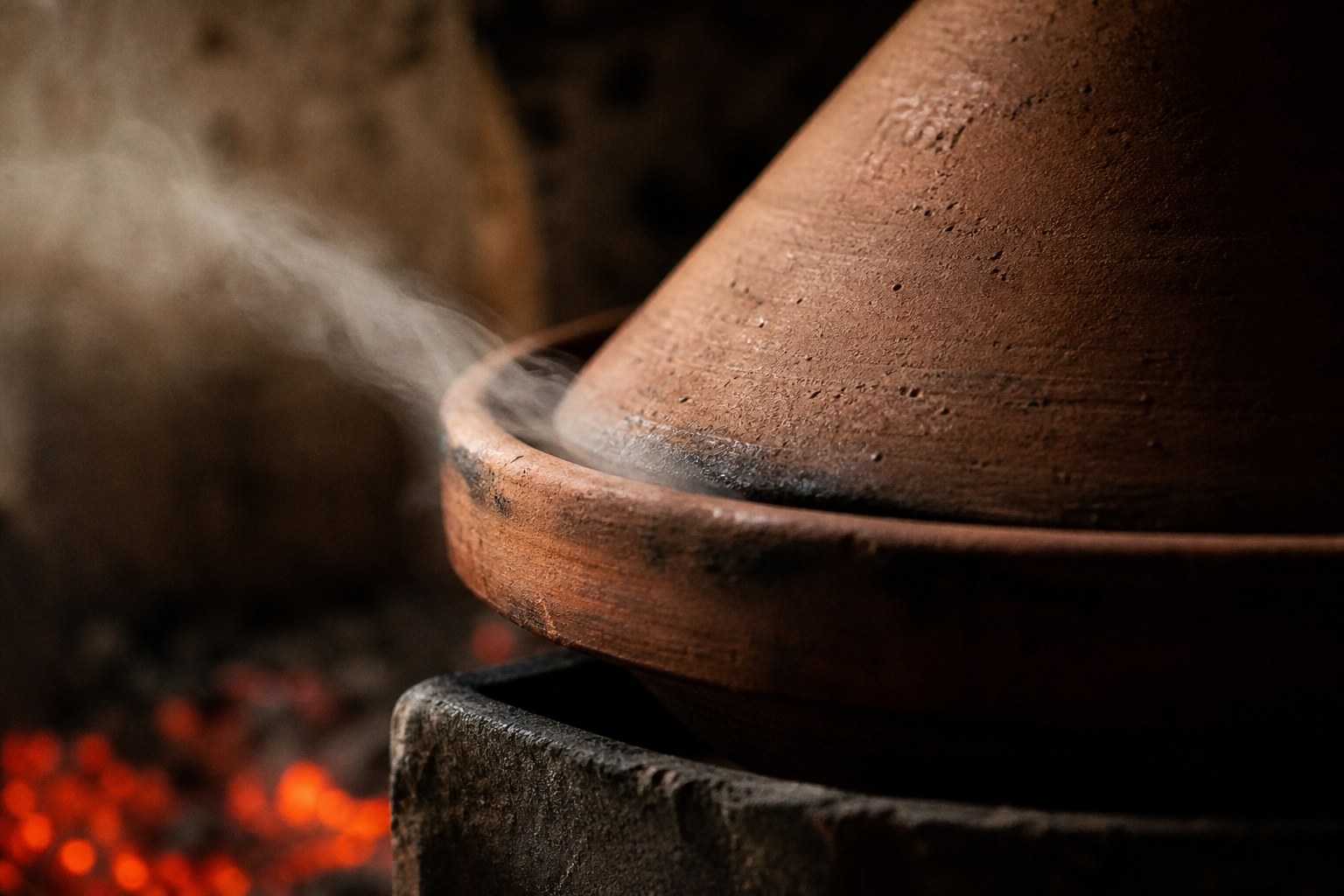
The tanjia is named after its vessel: a narrow-necked clay amphora, slightly bigger than a wine bottle. This is the first point of confusion for anyone who has only seen a tagine. The tagine is a wide, shallow dish with a conical lid, flat base, broad circumference, designed to be opened over a fire and served at the table. The tanjia is the opposite. It is tall, narrow, sealed at the neck, and it never opens during cooking.
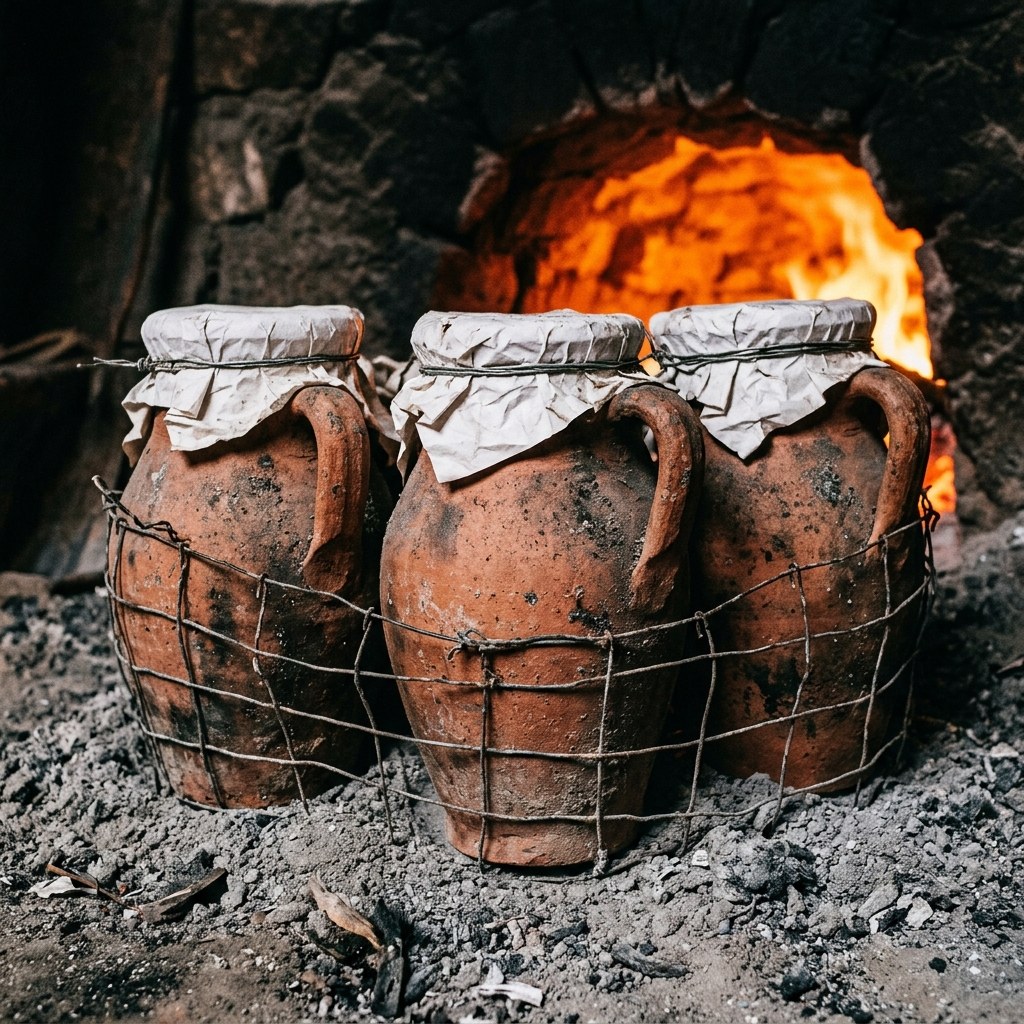
The ingredients go in raw: lamb shoulder in large pieces, preserved lemon quartered, cumin, saffron bloomed in warm water, smen (Moroccan aged butter), olive oil, turmeric, salt. The neck of the jar is covered with a round of paper and tied tightly with twine. That is the last time the jar is opened until it is time to eat.
No liquid is added. No water, no stock, no broth. The lamb will make its own. Six to eight hours at low heat, sealed inside a clay vessel no wider than a man's forearm, and the meat produces enough moisture to braise itself completely. The smen and the olive oil are there to start the process. After an hour, the jar is doing the rest.
"The jar is the cook. I am only the one who seals it."
Brahim, on what makes tanjia different from everything else he makes
The hammam, not the kitchen
The tanjia does not cook in a kitchen. This is not a preference. It is the definition of the dish. A tanjia cooks in a hammam, the public bathhouse, in the furnace room beneath the floor. The hammam is heated by a wood-burning furnace that runs continuously to warm the bathing chambers above. The ferrash, the hammam attendant responsible for the furnace, buries the sealed tanjia jars in the warm ash at the base of the fire. They sit there, upright, at around 80°C, for six to eight hours.
This is not improvised. It is a city-wide institution with its own economy and its own schedule. On Thursday evenings, men from across the Marrakech medina bring their tanjias to the neighbourhood hammam. They pay the ferrash a small fee, negotiated in advance, sometimes supplemented with a portion of the finished dish, and they leave. They come back the next morning, Friday, before prayers. The jar is ready. The ferrash knows.
By that point, the lamb has essentially dissolved into itself. It comes apart at the touch of a spoon. The saffron has turned everything a deep, even gold. The preserved lemon has lost its sharpness and become something else, savoury, almost sweet, threaded through the meat. The sauce at the bottom of the jar has never touched a direct flame. It is reduced purely by steam, by the slow physics of a sealed clay vessel in warm ash. It is thick, sticky, concentrated. You eat it with bread and your hands, standing up, on a Friday morning in the medina.
Note what this means geographically. Tanjia marrakech is not a Moroccan dish in the broad sense. It is not from Fez. Fez has no tanjia tradition. Casablanca does not know it the same way. Rabat has other things. This dish exists in one city, served in one specific cultural context, on one day of the week. It is hyperlocal food in the most literal sense, tied to a place, a ritual, and a piece of urban infrastructure that has not changed in centuries.
Why it is not a tagine
People confuse them because they are both slow-cooked Moroccan lamb dishes. That is the full extent of the similarity.
A tagine is cooked in a wide, flat clay base under a conical lid, over charcoal, in a kitchen, for three to four hours. The lid circulates steam back down over the meat, we wrote about the geometry of this separately; it is a piece of engineering, not decoration. A tagine produces a sauce. It is a family meal. It is served at the table, in the vessel, with the lid lifted for effect.
A tanjia is cooked in a sealed amphora, in ash, outside the kitchen, for six to eight hours. It produces not a sauce but a concentrated juice, reduced, sticky, nothing like the loose broth of a tagine. It is traditionally a men's dish, made on Thursday, collected Friday morning, eaten standing up or in the street before the call to prayer. The clay of a tanjia is porous and thick-walled, suited to long, static heat. A tagine lid is thin and conical, engineered for airflow. The two vessels have nothing in common except material.
Tagine is a family meal. Tanjia is a city's meal. The two dishes have about as much in common as bread and cake. They are both made from flour. That is where the comparison ends.
What goes inside
The recipe is almost embarrassingly simple. Per tanjia for two:
- 500g lamb shoulder, cut into large pieces, not small. They need to survive eight hours without disintegrating entirely.
- 1 preserved lemon, quartered
- 1 tsp ground cumin, ours comes from the same supplier Brahim has used since 1981
- ¼ tsp saffron, bloomed in one tablespoon of warm water for ten minutes before it goes in
- 1 tbsp smen, Moroccan aged butter. The smell is alarming. The result is not.
- 2 tbsp olive oil
- 1 tsp turmeric
- Salt
The jar is sealed. Nothing else happens until morning.
If you are making this at home, without access to a hammam furnace, a slow cooker set to its lowest setting for eight hours is the nearest approximation. It will not be the same. The ash heat of a hammam furnace is exceptionally stable, no cycling on and off, no temperature spikes, and the clay of the tanjia responds to it differently than it responds to an electric element. You will get something good. You will not get what Brahim gets on a Friday morning.
Brahim says the only way to ruin it is to open the jar early. He said this the way someone says something they have watched happen.
"The only way to ruin it is to open it early."
Brahim, on patience
Where to eat tanjia in Marrakech
Most traditional restaurants in the medina serve tagine. Fewer serve tanjia, it requires preparation that begins the day before, and the discipline to commit a full batch to a dish that cannot be accelerated for a table who just sat down. We serve it at Le Vrai Traditionnel, on our kitchen menu, on Fridays, when Brahim has had time to prepare. We do not put it on the permanent menu because we make it properly or we do not make it at all.
Call ahead. Or reserve for a Friday and mention tanjia in your notes. We will hold it for you.
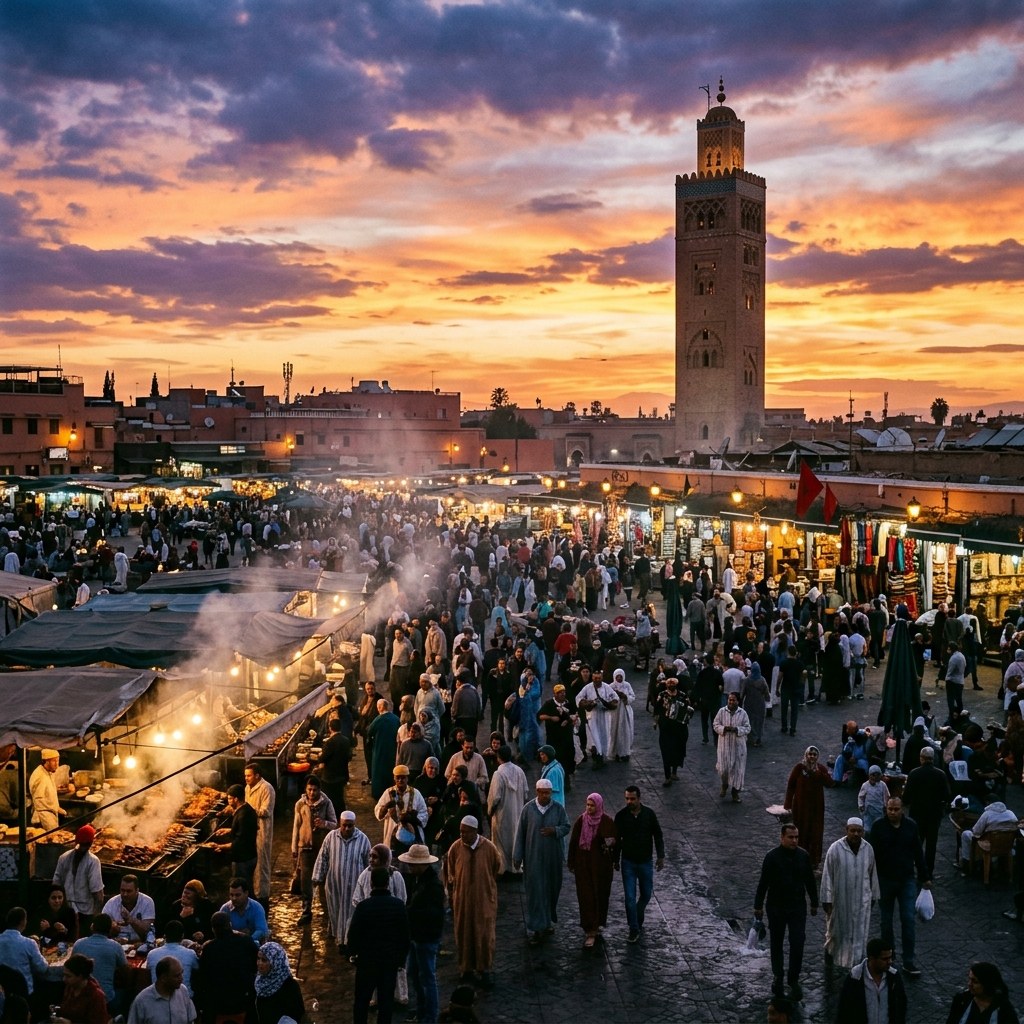
Outside our kitchen, the best tanjia in Marrakech is the one you find at the small stalls near Jemaa el-Fna on Friday morning, the men with the clay jars and the paper wrapping, eating standing up, before the call to prayer. That version is not presented for tourists. It is not framed as an experience. It is just Friday morning in Marrakech, the way it has been every Friday morning for a very long time. If you are looking for where to eat in Marrakech and you are there on a Friday, go before nine. Bring bread. You may need to point, not speak. That is fine. Our guide to eating in Marrakech covers this in more detail.

Brahim's one note
I asked Brahim what he would change about the recipe if he started today, from scratch. He thought about it for longer than I expected. He is not a man who thinks slowly about things he knows well. He was quiet for a moment. Then he said: "Nothing. I would change nothing."
He paused.
"Maybe the smen. The smen is harder to find good now."
That is the only modernisation he has considered in forty-three years of cooking. The smen, the aged butter, the one with the alarming smell, has become harder to source at the quality he expects. Everything else: the cumin from the same supplier, the preserved lemons, the saffron, the timing, the temperature, the paper tied at the neck of the jar. None of it has moved.
He does not own a meat thermometer. He never has. He knows when a tanjia is ready the way he knows when the weather is about to change, by means that are real, that can be learned, and that take longer than most people are willing to spend learning them.
If you come to us on a Friday and the tanjia is ready, it is worth the trip from wherever you are staying. Brahim has been making it the same way since 1981, and the recipe has not changed once.